
What Is Sildenafil? Uses, Dosage, Side Effects

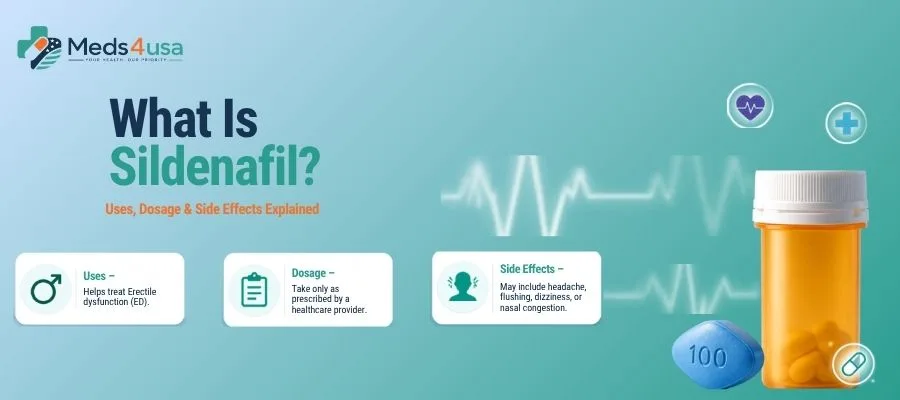
What is Sildenafil?
Sildenafil is an FDA-approved drug for helping men with erectile dysfunction (ED). ED is generally described as the inability to gain or sustain an erection that is adequate for intercourse. Sildenafil is classified as a phosphodiesterase type 5 (PDE5) inhibitor. PDE5 inhibitors drugs help improve circulation in certain regions of the body.
Originally, Sildenafil was developed as a drug for cardiovascular diseases, but one of the side effects of the drug was improved erectile function. Because of this, it is now one of the leading drugs for ED, worldwide. Physicians can prescribe both the name brand and its generics.
For men, taking Sildenafil helps you achieve a firmer erection with sexual stimulation. It is important to note that this drug will not help you with ED permanently and does improve your sexual urges.
How Does Sildenafil Work?
When you are trying to understand how drugs and especially Sildenafil works, you should know how the body reacts to gain an erection.
At the point of gaining a sexual erection, the body will produce and release an element called nitric oxide. Nitro oxide will help produce an increased amount of the chemical cyclic guanosine monophosphate (cGMP). CGMP helps to relax the smooth muscles of the blood vessels in the penis and therefore increases the blood supply.
During this time, what normally happens, an enzyme PDE5 will break down CGMP and your erection will subside. Sildenafil inhibits the PDE5 enzyme. Now CGMP can remain longer and the blood flow can be improved and maintained.
Sildenafil is effective when sexual stimulation occurs, as it does not elicit an erection at rest.
What Is Sildenafil Prescribed For?
Typically, Sildenafil is most known for its role in the management of erectile dysfunction (ED) for men.
When packaged under other pharmaceutical labels, it can be prescribed to regulate the conditions of pulmonary arterial hypertension (PAH) at the higher lung blood pressure. However, the treatment for PAH Sifferen dosage is distinct from the treatment of ED.
Sildenafil can be used to optimize ED when taken prior to the planned coitus.
Recommended Dosage
The prescribing provider, your age, health status, and the possible interactions with the other clinical therapies you are undergoing will influence the appropriate dose of Sildenafil.
For the management of erectile dysfunction, the following is common practice:
25 mg – Prescribed for older patients and patients with select co-morbidities.
50 mg – The standard dose for the average adult.
100 mg sildenafil – For the patients who tolerate the 50 mg and it has no adverse effects, but has no positive effects.
Typically, patients take Sildenafil 30 to 60 minutes prior to planned sexual engagement, and it is discouraged for patients to take multiple doses in a single day.
Bring any concerns about the dosage to your provider, do not modify prescribed dosages for personal preference.
Common Side Effects
Similar to every pharmacologic intervention, there is the potential for adverse effects with the use of this medicine, but the occurrence is not universal.
Some side effects that tend to occur are:
- Headache – 16%
- Flushing – 10%
- Indigestion (Dyspepsia) – 7%
- Nasal Congestion – 4%
- Blurred Vision or Blue Tint – 3%
- Dizziness – 2%
- Rash – 2%
- Diarrhea – 2%
- Muscle Pain – <2%
- Back Pain – <2%
- Nausea – <2%
These side effects are usually mild and often get better as the medication gets out of the system.
Contact your healthcare provider when side effects get severe or become long lasting.
Serious Side Effects
It is uncommon, but this drug can cause severe side effects that are potentially life threatening.
You should get emergency medical care for the following:
- Chest Pain, during and after sexual activity
- A painful 4 or more hour erection (priapism)
- Sudden Loss of Vision
- Sudden Loss of Hearing
- Severe Allergic Reactions, including facial swelling and trouble breathing
- Fainting and severe dizziness
These rare reactions need to be assessed by a medical professional.
Who Should Avoid Sildenafil?
This medication is not appropriate for everyone.
Before using Sildenafil, you must consult your physician if you:
- Take nitrate medications for angina
- Have serious cardiac conditions
- Have had a heart attack or stroke recently
- Have chronic low blood pressure
- Have severe liver or kidney disease
- Have some inherited retinal diseases, such as retinitis pigmentosa
- Have a hypersensitivity to Sildenafil or any of its constituents
It is contraindicated in the above conditions.
Drug Interactions
Medications may interact with Sildenafil and cause adverse effects.
Tell your physician if you are prescribed:
- Nitrates
- Alpha-blockers
- Medications to control blood pressure
- Some antifungals
- Some antibiotics
- HIV protease inhibitors
- Other medications for erectile dysfunction
Sildenafil and medications for erectile dysfunction may not be used together.
The combination of Sildenafil and alcohol is not advisable. Alcohol may cause more side effects and will reduce the effectiveness of Sildenafil.
Frequently Asked Questions
How long usually has an effective duration of 4 to 6 hours.
Can I take Sildenafil every day?
- It can be taken when needed or as a scheduled daily medication, depending on the healthcare provider’s advice.
How quickly does Sildenafil work?
- The onset of Sildenafil is 30 to 60 minutes, but may take longer if there is a large meal, and the work of Sildenafil is not instantaneous.
Conclusion
This drug is one of the most popular prescription medications to treat the erectile dysfunction. It has been researched a lot for its safety and effectiveness. It helps a lot of men form and maintain an erection during sexual activity by increasing blood flow during sexual activity to the penis.
Sildenafil, like other prescription medications, should be taken as instructed by your healthcare provider. It is important to know the dosage, the side effects, and drug interactions to use of this medication safely and effectively.
Sildenafil can be appropriate for a lot of men. If you think that you are one of those men, talk to your healthcare provider to see if it is an appropriate medication for you.